

|
Bruno Reinhard
Recorder Maker |
Tel. : +33 4 90 62 39 20 |
|

Mont Ventoux seen from my workshop Discography Links |
 Discography:
Here are some recordings made with “my” recorders.
|
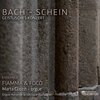
The ensemble Fiamma & Foco is well worth discovering if you do not know it yet. This subtle and refined CD, “Bach – Schein, Geistliches Konzert” (released in 2023), presents an engaging program in which organ pieces alternate with works combining voice, recorders and sackbuts. An unusual line-up and captivating tone colors. A wonderful discovery, including several rarely performed pieces. Bravo! Élodie Bouleftour plays one of my alto recorders at A = 440 Hz after Denner, as well as one of the rare “Ganassi” sopranos I have made. |

|
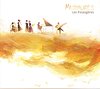
In 2018 came “Le Petit Tour”, the recital of a new ensemble, Les Passagères, with Léa Grenet on recorder and her partners on voice and viola da gamba, supported by a fine continuo of theorbo and harpsichord. The journey takes us between Italy and France from the 16th to the 18th century, in a beautiful and truly captivating program. Among other instruments, Léa plays one of my recorders at A = 415 Hz after Stanesby Junior. |
|
Released in 2021, “Murmures”, the second album by the young ensemble Les Passagères, takes us on a richly varied musical journey through 17th- and 18th-century Italy and Germany. The recipe is the same as on their first album, even though some of the musicians have changed (two singers, recorder, viola da gamba and a generous continuo of harpsichord and theorbo). A “concert” to savor again and again. Once more, Léa plays with great talent my well-known alto after the Stanesby Junior recorder kept in Paris. Speaking of this recorder, do take a look at the whole “facsimile” reconstruction project I carried out for the Paris museum together with Héloïse Gaillard of the ensemble Amarillis. The account of this adventure accompanies the CD released at the same time, “Melodies in Mind” (see below). |
|
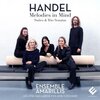
The album “Melodies in Mind”, devoted to Handel, features the ensemble Amarillis (Héloïse Gaillard, recorder; Alice Piérot, violin; Violaine Cochard, harpsichord; Annabelle Luis, cello). Héloïse Gaillard plays the facsimile, made by Bruno Reinhard, of the alto recorder by Thomas Stanesby Junior (inventory no. E.980.2.82) in the collection of the Musée de la musique in Paris. Back to the origins, or how to reconstruct Thomas Stanesby Junior's exceptional alto recorder: some time ago, Héloïse Gaillard and Violaine Cochard proposed to the Paris instrument museum a concert built entirely around works by Handel, using as far as possible original instruments from the museum's collection, close to those that might have been played in London at the time. ▸ Read more▾ Show lessSome of the harpsichords can be restored to playing condition, but this is not the case with woodwind instruments, which suffer too much damage when played, because of the moisture of the player's breath. In such cases, the museums' policy is to commission a “facsimile*” of some of the remarkable instruments in their collections, so that today's audiences can hear their subtle tone. For this project I was approached both by the museum team, for whom I had made in 2015 a facsimile of one of the two ivory altos by the Hotteterre family in their collection, and by Héloïse Gaillard, with whom I have long worked closely on several of the recorders I reconstruct. It is a major three-way project that has greatly advanced our knowledge of these instruments, and it is a real privilege for the “fleustier” that I am (an old French word for a recorder maker) to benefit from the findings of the museum's laboratory (acoustics, CT scans of the joints, staining processes, profiles…) and to hear the sound of my reconstruction in the hands of an artist as accomplished as Héloïse. Last spring we met to choose together the recorder best suited to this Handel project. Of the two instruments in the museum's collection (an alto attributed to Peter Bressan and another to Thomas Stanesby Junior), we quite quickly settled on the Stanesby, as the Bressan presents some features that have not yet been explained. The recorder by Thomas Stanesby Junior, who worked in London under his own name from 1713 to 1754 after serving his apprenticeship with his father, is a perfect match for the recorders used in Handel's orchestra (1685–1759). This period marks the high point of recorder making and playing, shortly before the instrument's decline in favor of the transverse flute. Bressan and the Stanesbys, father and son, distilled into their instruments all the knowledge accumulated since the Middle Ages, and made recorders that are remarkable in every respect (even, warm, balanced, agile, precise…). For today's instrument makers, they remain the ultimate reference. From the very start of my career in 1980, I had the opportunity to measure and examine every detail of this beautiful Paris alto, which is still in excellent playing condition, making the measurements all the more relevant. Back in the workshop, after making a first prototype based on my measurements, I immediately fell in love with this instrument. A deep bond formed at once between Th. Stanesby Jr's work and myself, as if there were a lineage between us, as if I had been his apprentice… It immediately became the only Baroque alto at historical pitch in my catalog, and has remained so to this day, nearly 40 years later! Since then I have probably delivered close to 300 recorders based on this single Paris original, which shows how intimately we know each other. So when the museum and Héloïse Gaillard asked me to reconstruct this recorder, it felt like finding the “Grail” at the end of the long road I had travelled alongside Th. Stanesby for so many years. I set to work straight away, aiming to get as close as possible to the sources: I went back to the museum several times to see the original instrument, taking new measurements and photographs. Héloïse was able to play two scales on it, which we recorded, and the museum's laboratory team worked hard to answer all my questions and to advance research in several areas (acoustics, wood science, wood treatment, staining…). I would like to thank this passionate and inspiring team, who make our knowledge of the past so vivid:
Thierry Maniguet, curator Going back to the sources opened my eyes to certain aspects of making that had escaped me at the start of my career, and applying these new elements changed the substance and character of the sound. With the recorder once again closer to the original, I attended the first concert as a delighted listener, savoring the delicious sounds Héloïse drew from this new version once she had fully tamed it, for it is harder to master than my usual reconstructions. May this recording bring you the pleasure I had in creating this reconstruction of Th. Stanesby's exceptional recorder, and in hearing it so masterfully showcased by Héloïse Gaillard and the musicians of the ensemble Amarillis, alongside the Longman and Broderip harpsichord played by Violaine Cochard.
Thank you. * The museum pursues a policy of commissioning instruments from contemporary makers. These are either facsimiles of original instruments held in the museum, or reconstructions or copies inspired by them. The fruit of research, these new instruments give back a voice to instruments that can no longer be played.
Review in Diapason – April 2018 (PDF, in French) |
|
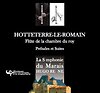
The album “Hotteterre Le Romain, flûte de la chambre du Roy” brings together Hugo Reyne on recorder and La Simphonie du Marais (Thomas Dunford, theorbo; Étienne Mangot, viola da gamba). This CD reflects a three-way collaboration between Hugo Reyne (recorder player), Bruno Reinhard (maker) and the team of the Paris instrument museum, with the aim of performing these works by Jacques Martin Hotteterre as close as possible to the original sound of a very beautiful ivory alto recorder (inventory no. E.978.2.9), one of the six recorders signed by the Hotteterre family in the museum's collection. ▸ Read more▾ Show lessMaking a true facsimile made it possible to recover, as far as possible, the tone, pitch, temperament and playing characteristics of the original instrument. Museums no longer allow their woodwind instruments to be played, as the moisture of the breath causes too much damage to these essential witnesses of the past. Working with the museum team, Bruno Reinhard strove to reproduce all the original characteristics, while staying strictly within these requirements, and used ivory supplied by the museum to recreate what could have been an instrument from the Hotteterre family workshops in La Couture-Boussey. Hugo Reyne brilliantly took up the challenge of playing this uncompromising recorder (single holes, historical fingerings…), refined, with a firm resistance and beautifully balanced. The concert at the Philharmonie 2 in Paris on December 7, 2015 was a success, as the recording made that day reflects. The “facsimile” recorder made for the occasion is now on display at the museum and is intended to be played at the small concerts regularly held there.
Review on ResMusica (in French) |

|
Released in March 2017, the latest vintage from the ensemble Amarillis, with Héloïse Gaillard on recorder and oboe. “Effervescence” is just the word: sparkling and infectiously warm, this is a CD I regularly play in my workshop without ever tiring of it. A selection of the finest Telemann, paired with Bach's essential Concerto for oboe and violin (masterful). In Brandenburg Concerto No. 4, Meillanne Wilmotte joins Héloïse on recorder (a duo of two of my recorders after the ever-essential Stanesby Junior kept at the Paris instrument museum). |

|
This album by the ensemble Les Passions, directed by recorder player Jean-Marc Andrieu, brings together various follias, some famous, others little known. Jean-Marc plays one of my altos after Stanesby Junior, made many years ago. You will hear it in the spotlight in Corelli's famous Follia and in Purcell's Chaconne. The album has received many excellent reviews. |

|
This album by the ensemble Céladon, entitled Nuits Occitanes, celebrates love through troubadour songs. The ensemble invites us to a musical meditation, in which the instruments punctuate the singing with restrained, inspired interventions. Among other recorders, Gwenaël Bihan plays a tenor in Pythagorean temperament, made specially at his request. |

|
Here Héloïse Gaillard releases a solo album devoted to Telemann's Fantasias. It was widely acclaimed by the critics and received a “Choc” award from Classica magazine. Unlike many other players, Héloïse Gaillard uses several recorders of different sizes. Among those from my workshop, you will hear the voice flute after Denner and the alto after Stanesby Jr. A feast of tone colors at the very heart of the sound… |

|
Los Biganos, a young seven-piece ensemble founded in Strasbourg in 2008, offers a real firework display of early and traditional music from around the Mediterranean, re-orchestrated and arranged by the musicians themselves, with a delicious, sparkling result. Here and there across the tracks you will hear three instruments from my Renaissance consort (bass, tenor and alto in F). To be enjoyed without moderation. Available from Éditions du Tourdion. |

|
An album released by the Ambronay label, capturing a concert given by the ensemble Amarillis and Stéphanie d'Oustrac at the 2010 autumn festival. Two of my recorders, played by Héloïse Gaillard (alto after Th. Stanesby Jr. and voice flute after Jacob Denner), keep fine company with Stéphanie d'Oustrac in an eclectic program. |

|
The Strasbourg ensemble Le Tourdion, directed by Alain Sobczak, offers a very enjoyable compilation of 17th-century English pieces. In one of them you will hear three instruments from my consorts (bassett in F, tenor, alto in F). I cannot recommend Le Tourdion's other albums highly enough, especially the superb one devoted to music from Strasbourg. Albums available from Éditions du Tourdion, 111 Grand'Rue, 67000 Strasbourg, France. |

|
Here is Amarillis's new annual album.
You will hear my reconstruction of the Stanesby Junior alto kept in Paris, entwined with the beautiful voice of Stéphanie d'Oustrac. |

|
Thanks to Jean-Marc Andrieu for straying off the beaten track and giving us a very festive album of works by Scarlatti, some of them previously unrecorded.
|

|
A completely forgotten composer who nonetheless deserves his place in the pantheon of Baroque composers. On the menu: a bouquet of Italian-style concerti and French-style dances. Plenty of warmth and color; in one of the movements you will hear my Stanesby recorder, played by Armèle Brouard-Plantier. |

|
Gwenaël Bihan continues his collaboration with the ensemble “Les Jardins de Courtoisie”; here he plays a tenor recorder in Pythagorean temperament of my making. A very beautiful recording, to be listened to with your eyes closed and in complete silence, to savor its meditative quality. |

|
Still faithful to my reconstruction of the Stanesby Junior alto kept in Paris, Héloïse Gaillard continues year after year her work combining pieces for recorder with pieces for oboe in delightful “concert” albums. This one is devoted to some very beautiful pieces, both well known and less familiar, with David Plantier on violin and the ensemble Amarillis.
|

|
Carnetz Secretz de Marguerite d'Autriche. Les Jardins de Courtoisie, directed by Anne Delafosse Quentin.
|

|
Inconstance et Vanité du Monde, Musique aux cours de France et Savoie en 1601. Directed by Anne Quentin, with Gwenaël Bihan (Renaissance tenor and “Ganassi” alto), on Astrée Naïve. |

|
Machaut, Intégrale des Motets (the complete motets). Ensemble Musica Nova, with Gwenaël Bihan on recorder (tenor in Pythagorean temperament), on Zig-Zag Territoires, distributed by Harmonia Mundi.
|

|
Europe Baroque.
|

|
Vivaldi, Concertos for recorder (sopranino and alto) and oboe. Ensemble Amarillis, on Ambroisie. Over the past few years, Héloïse Gaillard has made extensive use of one of my Stanesby recorders at A = 415 Hz in several recordings with the ensemble Amarillis. |

|
Handel, Sonatas for recorder or oboe. Ensemble Amarillis, on Ambroisie, with Héloïse Gaillard on recorder (Stanesby alto, A = 415 Hz). |

|
Jeu de Dames à la cour (18th-century French music). Ensemble Amarillis, on Ambroisie (distributed by Harmonia Mundi), with Héloïse Gaillard on recorder (Stanesby alto, A = 415 Hz). |

|
Aria, Johann Sebastian Bach. Ensemble Amarillis, on Ambroisie, with Héloïse Gaillard on recorder (Stanesby alto, A = 415 Hz). |

|
Barsanti, Sonatas. Jean-François Alizon (Stanesby alto, A = 415 Hz), on Tamino. |

|
Hotteterre, Pieces for recorders and basso continuo. La Messinoise. Jean-François Alizon and Anne-Marie Bastian on recorders (Stanesby altos, A = 415 Hz). Of particular note: a trio sonata featuring both recorders together.
|

|
Rural Café, En suivant la draille... Nicolas Zorzin on recorders (“Van Eyck” soprano and Reinhard Baroque alto, both at A = 440 Hz), on Mustradem.
|

|
Rural Café, Les couleurs du cercle. Traditional music from the Ardèche and beyond. Nicolas Zorzin on recorders (“Van Eyck” soprano and Reinhard Baroque alto, both at A = 440 Hz), on Mustradem.
|

|
Canto Mediterraneo, Capriccio Stravagante. Patricia Lavail (“Van Eyck” soprano, A = 415 Hz), on Audivis. |

|
Charpentier, Office des ténèbres. Sabine Weill and Nicolas Stroesser (Stanesby alto, A = 415 Hz), on Opus 111. |
Links:
General recorder websites:
 Recorder Homepage: indispensable, everything you need to know.
Pascal Premier's website (in French): among other things, it lists some fifty recorder makers around the world, with a detailed description of their work.
Websites of fellow instrument makers:
Baroque and Classical bows by Solange Chivas: Solange, who recently set up her own workshop, is known for the quality of her bows. We are neighbors and friends.
Local websites:
Official website of Caromb (in French): everything about my charming village (its olive groves, vineyards, medieval monuments, etc.).
Other:
Dúshlán, Celtic and Irish music ensemble.
Rural Café, traditional music ensemble.
Essential websites to broaden your horizons:
Bibliothèque nationale de France (French National Library)
IMSLP, a treasure trove of public-domain scores and facsimiles.
Werner Icking Music Archive, another treasure trove.